Why “best time” feels like it should exist
You can feel the urge to pin it down to a single moment: first sip of coffee, right after the gym, last thing before bed. Collagen ends up in the same mental category as a multivitamin or creatine—something that seems like it should have an “optimal window,” because it’s easier to follow rules than to watch for slow changes.
But collagen doesn’t usually reward that kind of precision. If anything shifts day to day, it’s the habit around it. A “morning collagen” routine often means it’s tied to a reliable cue (coffee, breakfast, commuting), while an “evening collagen” routine can feel calmer but is easier to forget if dinner runs late or you fall asleep on the couch.
Timing can change how it feels, even if it doesn’t clearly change results. Taken on an empty stomach it may sit fine for one person and feel slightly queasy for another. With food it may feel smoother, but it also blends into the noise of everything else you eat—making the illusion of a perfect time feel even more tempting.
Collagen works slowly, so consistency dominates timing
A week in, it’s common to start “checking” in the mirror or flexing a knee on the stairs, and nothing feels different. That’s usually where timing theories rush in—maybe it needs to be at night, maybe it needs to be before food, maybe coffee “ruins” it. The slower the payoff, the more your brain looks for a lever you can pull today.
But collagen is more like a background deposit than a quick switch. If you take it most days, your total intake over weeks tends to matter more than whether it landed at 7 a.m. or 9 p.m. The practical issue is that real life doesn’t do perfect streaks: travel, skipped breakfasts, late meetings, fasting windows that shift, a tub you forget to replace. Inconsistent dosing can easily look like “it stopped working,” when it may just be hard to notice a gradual effect without a steady pattern.
What ends up driving the experience is less the clock and more the container you put it in—coffee you never miss, a post-workout shake you only have some days, or a bedtime routine that disappears when you’re tired. If it regularly makes your stomach feel off in one setup, that discomfort alone can be enough to break the habit, even when the timing sounds “ideal.”
Morning use versus evening use feels different
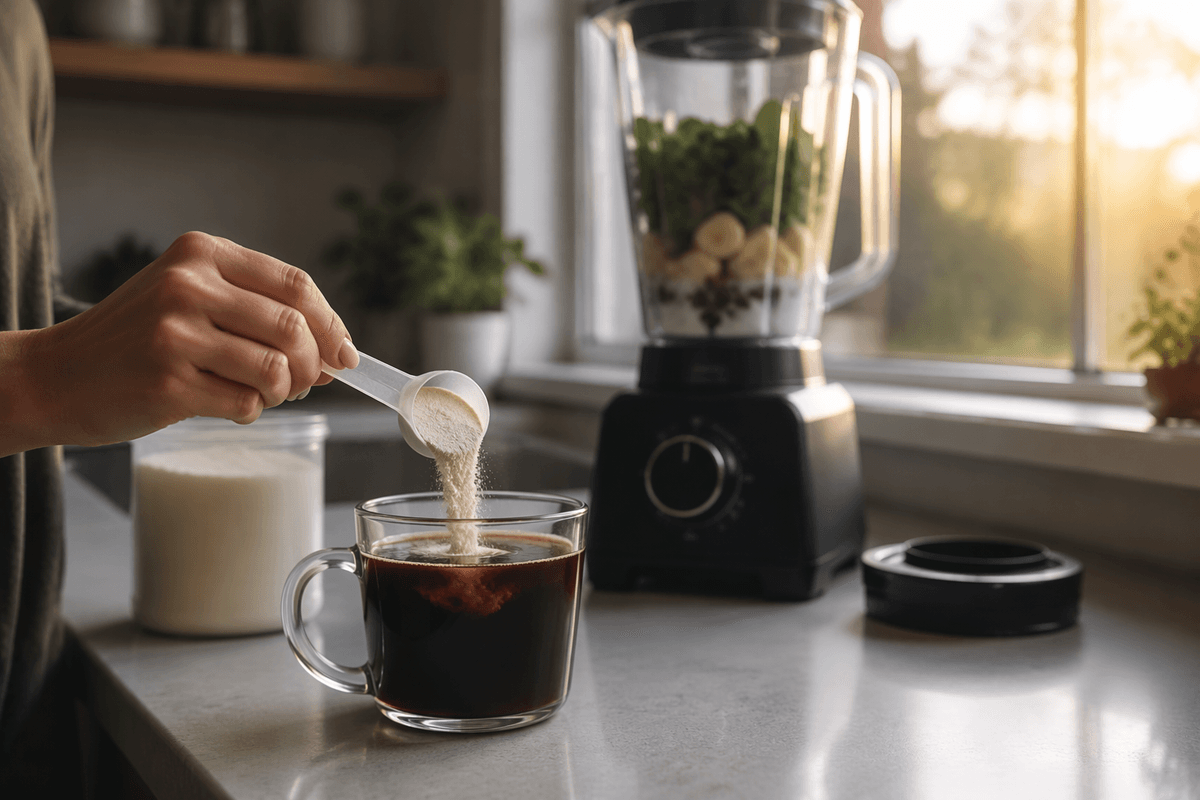
Some mornings it goes down like nothing—collagen stirred into coffee or a quick smoothie—and you barely register it until you realize you’ve been taking it almost every day. Other mornings, the same scoop lands differently: a slightly hollow feeling, a faint nausea edge, or a subtle “sits there” heaviness that makes you think timing must matter more than it does.
Evening use can feel smoother for a different reason. Your stomach is rarely as empty, your pace is slower, and you’re not stacking it on top of caffeine, rushing, or a workout. But that calm can be misleading, too: collagen becomes one more optional step at the end of the day, and optional steps are the first to disappear when dinner is late, you snack instead of eating, or you fall asleep before you remember.
What people often notice isn’t a better “effect,” but a different kind of tolerance. Morning collagen tends to compete with coffee, fasting windows, and appetite cues; evening collagen tends to compete with fatigue and irregular schedules. Over a few weeks, the “best time” can end up being the one that keeps both your stomach and your routine from pushing it out.
Food, fasting, and the digestion trade-offs
The first clue it’s not just about the clock is how often collagen gets “tested” against an empty stomach. You mix it into black coffee, feel fine for an hour, and then notice a vague churn or appetite rebound that makes you wonder if you broke your fast or did something wrong. Other days, the exact same setup feels completely neutral—enough inconsistency to keep the timing debate alive.
Food changes the experience in a predictable way: it tends to buffer. With a meal, collagen is less likely to feel like it’s sitting on top of nothing, and it blends into digestion that’s already underway. The trade-off is psychological more than chemical—when it’s folded into breakfast or lunch, it becomes harder to “feel” anything from it, so people assume it’s less effective, when it may simply be less noticeable.
Fasting adds another layer because the routine has stricter edges. If your first calories happen later in the day, collagen either becomes part of that first meal (easy to remember, but not “early”), or it becomes a separate decision that can trigger mild nausea, reflux, or just a sense that coffee is harsher than usual. In practice, the better fit is often the version that doesn’t make you dread the next scoop.
Workouts, tendons, and protein timing expectations

You notice it most on workout days: the scoop suddenly feels like it belongs “around training,” the way protein shakes and pre-workout rituals do. If a tendon feels cranky on a run or your elbows complain during presses, it’s easy to assume collagen has a window—take it right before, and it will somehow show up where it’s needed.
But collagen doesn’t behave like a quick fuel. It’s more like a specific set of amino acids you’re adding to the day, and the main swing factor is whether you’re actually getting enough total protein overall. In that context, a post-workout shake can be a great anchor, but it’s also inconsistent for a lot of people: rest days, skipped sessions, or workouts that happen too late to want another drink.
If you take collagen right after lifting, you may “listen” for immediate joint feedback the way you’d notice soreness or pump, and nothing lines up. The timing can feel wrong when the real friction is simpler: the dose drifts, the routine breaks, or your stomach only tolerates it when it’s folded into a normal meal.
When a reasonable routine causes unexpected discomfort
It usually shows up as something small you can’t quite blame on the collagen at first: a faint burn after your coffee, a little throat-clearing that wasn’t there last week, or a stomach “drop” that makes the rest of the morning feel slightly off. Because the routine is so reasonable on paper—one scoop, same time every day—it’s easy to assume you’ve discovered the wrong window.
More often, it’s the combination that’s doing the work. Collagen itself is typically mild, but stacking it onto an empty stomach, hot caffeine, a rushed commute, or a tight fasting window can make digestion feel touchier than usual. If you’re mixing it into very hot drinks, the texture can also change in a way that feels heavier going down, which some people interpret as nausea or reflux even when it’s more of a “sits there” sensation.
One day it disappears; the next day the exact same scoop feels like a mistake—so the habit starts to wobble. In practice, discomfort often becomes the real timing “signal,” not because the clock matters, but because any routine that makes you hesitate is harder to keep steady for the weeks it usually takes to notice anything.
Choosing a time that survives real-life uncertainty
It’s easy to swear you’ve found your perfect timing—until the week that blows it up. A morning that starts with travel coffee and no breakfast, a workout that slides to late afternoon, a dinner that turns into grazing, and suddenly the “best time” is just the time you didn’t manage to hit.
What tends to hold up isn’t a specific hour, but a cue that survives messy days. Coffee is reliable for some people, but it can be the exact thing that makes an empty-stomach scoop feel sharp. Post-workout works when training is consistent, but it disappears on rest days. A meal-based cue is less exciting, yet it often wins because it’s harder to accidentally skip eating than it is to remember a supplement.
Over a few weeks, the useful question becomes: when do you take it with the least friction? If a setup repeatedly makes you a little nauseated or refluxy, that discomfort can quietly cut your weekly total more than any “optimal window” could help. The routine that stays boring and repeatable is usually the one that gives you the cleanest read on whether collagen is doing anything for you at all.