A gap year isn’t a trip—it’s a new life.
At 9:47 p.m., with two lunchboxes drying on the rack and a calendar app open, I hovered over a “one-way” flight for late August and couldn’t click buy. The fare was fine; it was the tiny line underneath—“nonrefundable”—that made me pause. A vacation mistake costs you a day. A gap-year mistake lands on a Monday morning when school starts, your kid’s uniform isn’t right, and you’re still arguing with a landlord over keys.
That’s the mental switch to make early: a gap year behaves less like travel and more like a household transplant. You’re not just optimizing “best neighborhoods” the way you would for a week; you’re optimizing commute loops, grocery friction, noise, and how quickly you can get a pediatric appointment when someone spikes a fever. Flexibility is the obvious upside—new language, new routines, lighter stuff—but it trades directly against predictability: school enrollment windows, lease terms, visa validity, and the cost creep that shows up when you’re tired and default to convenience.
It also punishes last-minute planning in ways short trips don’t. Flights can move; a school start date rarely does, and your best housing options usually disappear 6–10 weeks before arrival. This year-long version works best for families who like a repeatable weekday rhythm and can tolerate being “good enough” on sightseeing. If you’re chasing constant novelty, you’ll spend more—money and energy—and the kids will feel it first.
Choose your why, then your timeline
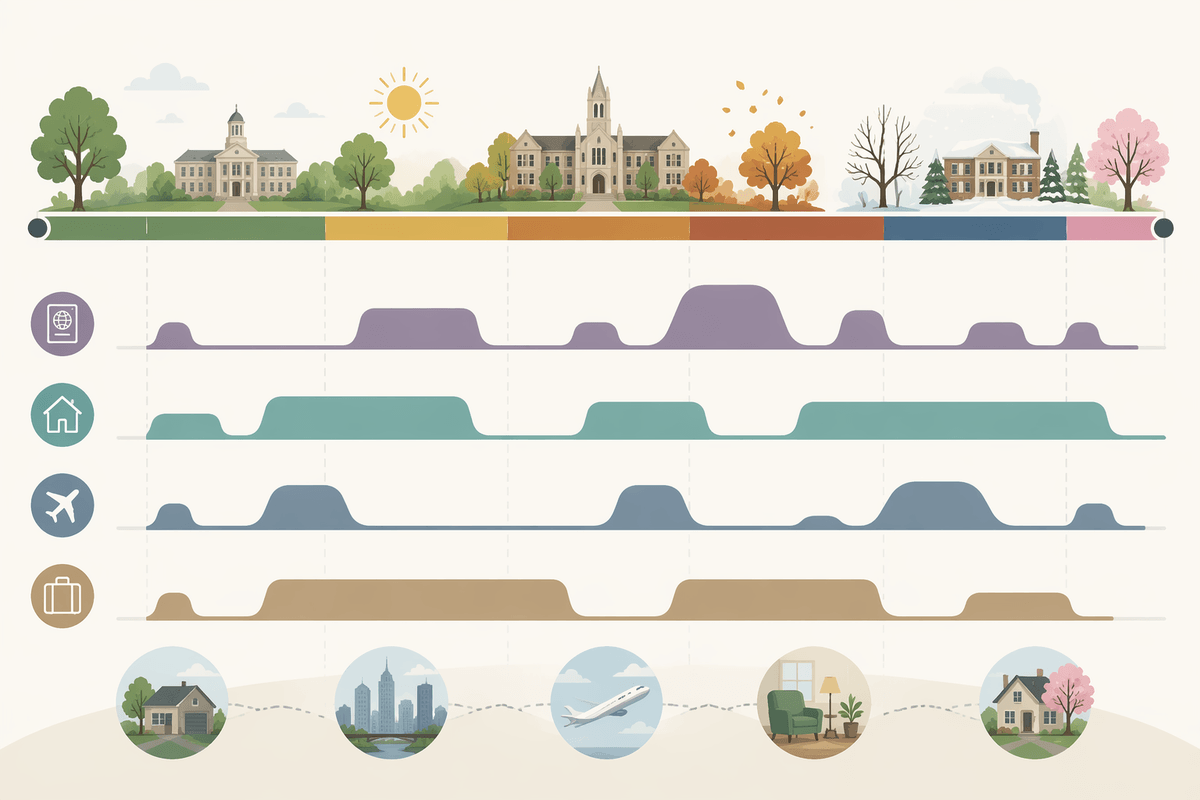
On a Wednesday night at 10:18, I drew a neat September-to-June bar across a spreadsheet and felt oddly confident—until I tried to place “visa appointment” and realized the consulate site only released slots a few weeks out. The map version of a gap year looks like school-year symmetry; the reality version is lumpy, with deadlines that don’t care about your preferred start date. That mismatch is where families lose money: a week of overlap rent, a rushed flight change, a “temporary” Airbnb that becomes three weeks.
Start with one primary “why,” not five. If your why is school continuity and calmer weekdays (most families with a 7- and 10-year-old land here), you’re building around a fixed school calendar and predictable housing—less novelty, fewer surprise costs. If your why is maximal travel or language immersion through constant movement, that can work, but it tends to punish dual-income parents: more planning time, more transit fatigue, and more spending when you default to convenience.
Then choose your timeline by working backward from immovable dates. For a 2026–2027 school-year plan, assume school admissions and waitlists start months before you arrive, and visas may take longer than your optimism. A 9-month stay can be easier than 12 if visa rules force a hard exit; a 12-month stay can be cheaper if it unlocks a standard lease and avoids peak-season month-to-month pricing. Pick the model you can repeat on a tired Tuesday, not the one that looks best on a Saturday.
Pick a base that fits daily life
At 7:12 a.m. on a drizzly Tuesday, we stood on a narrow sidewalk with backpacks, looking at the bus stop sign and then at the school gate two blocks away. It should have felt simple; instead, I was doing mental math on pickup timing, grocery distance, and whether a “15-minute walk” meant 15 minutes with kids or 15 minutes for an adult in sneakers. The neighborhood was charming in the listing photos, but the morning traffic made it feel louder than expected.
Choosing a base is less about the city’s highlights and more about the loops you’ll repeat 200 times: school run, errands, a park, a pharmacy, a backup rainy-day café. For dual-income parents, the best base usually isn’t the “most central” district—it’s the one where weekday logistics are cheap in time. A postcard neighborhood might mean an older apartment with weak heating or no elevator; a quieter residential area might mean longer transit when you want a weekend museum day. If you’re aiming for stability, prioritize a 20–30 minute school commute max and a grocery shop you can do without a car.
Then match your base to your visa and housing constraints, not your wish list. If you’ll be on a visa with a fixed end date, locking a 12-month lease can backfire; if you’re truly staying the full school year, month-to-month pricing can quietly blow up your $6–8k target once you add utilities and “we’re too tired to cook” meals. Families who like routine do well with one primary base and occasional long weekends; families who need constant movement often discover the hidden cost is fatigue, not flights. If you can picture a normal Tuesday there—and it still seems workable—you’re close.
Lock in school, paperwork, and healthcare

At 11:06 p.m., I had three tabs open—an international school admissions portal, a visa checklist PDF, and an insurance quote screen that wanted our kids’ birthdays down to the day. I kept thinking I was “almost done,” then hit one more field that required an address we didn’t have yet. It’s the classic gap-year loop: school wants proof of residence, landlords want proof of visa, and visas sometimes want proof of enrollment.
For families prioritizing routine, school is the anchor—start there, even if it means choosing a slightly less romantic neighborhood. A public-school route can be cheaper, but it’s often less predictable for newcomers (zoning, language support, enrollment timing), while private/international options cost more but behave more like a contract you can plan around. If you’ll be working US hours, also pressure-test the daily schedule: earlier start times, long commutes, and after-school coverage can turn “we’ll figure it out” into a recurring babysitter expense.
Paperwork and healthcare are where cost creep hides in boring clothing. If your visa is time-capped, don’t let a school deposit or a 12-month lease trap you into paying for months you can’t legally stay; if the visa path is sturdy, longer commitments usually buy calmer pricing. On the medical side, you’re balancing convenience versus certainty: travel insurance can be easy but limited for routine pediatric visits, while a more robust international plan may cost more upfront yet reduce the “cash now, reimburse later” stress. If you can’t explain your coverage at 2 a.m. in one sentence, it’s not locked in yet.
My checklist for a smooth first month
At 6:38 a.m. on our fourth morning, I realized we’d bought the “right” SIM cards but the kids’ school app still wouldn’t load on our phones without a local number format. I stood in the hallway with a paperclip, resetting the router we didn’t own, while a neighbor’s door buzzer echoed down the stairwell. That’s when I stopped pretending the first month is for exploring and started treating it like onboarding: lots of small tasks, each annoying on its own, expensive when you miss them.
Here’s the checklist I wish I’d followed in order. Week 1: make the address real (name on mailbox, signed lease, a utility bill if possible), because it unlocks everything else; choose convenience over charm here, even if it means a smaller apartment. Week 2: school logistics—confirm start date in writing, buy uniforms/books locally (packing “just in case” costs more than you think), and test the commute at actual drop-off time, not midday. Week 3: healthcare—identify one pediatric clinic and one after-hours option, then do a small “trial” visit or registration so your first sick day isn’t a paperwork event. Week 4: money and routines—set a weekly cash withdrawal rule, track groceries vs takeout for two weeks, and pre-decide one low-effort meal plan for jet-lag nights.
If you want stability on a $6–8k/month target, the trade-off is being boring early: fewer day trips, more admin, more repetition. Give yourselves a simple pass/fail test by day 30: can you run a normal Tuesday (school, work hours, dinner, bedtime) without improvising? If yes, you’ve earned the fun weekends; if not, change one constraint—usually commute, not city.