The real game isn’t the first price
I froze at the mouth of a narrow derb when the seller wrote “1,200” on a calculator and pushed it toward me like a final verdict. My partner and I were already sweaty from climbing the Ben Youssef Medersa stairs, and the crowd behind us kept pressing forward. Paying would’ve ended it in ten seconds; arguing felt like stepping onto a moving treadmill.
The real game here isn’t that first number—it’s how quickly you can turn it into a conversation without turning it into a scene. In the souks, the opening price is often more like a menu price than a quote: it’s designed for tourists who want speed, not for people who want a fair deal. If you’re mid-budget and only have three days, the trade-off is time versus precision. You won’t “win” every haggle, but you can avoid the obvious overpay.
I start by naming my interest, then cutting the number hard enough to be credible but not insulting: a calm “That’s too high for me—how about 500?” works better than a laugh or a lecture. If they counter fast, I move in small steps and watch for the moment their tone changes from salesy to practical; that’s usually the real range. When it stays theatrical or you feel rushed, thank them, take one step away, and let the market decide whether they call you back.
Know what’s normal in Marrakech souks
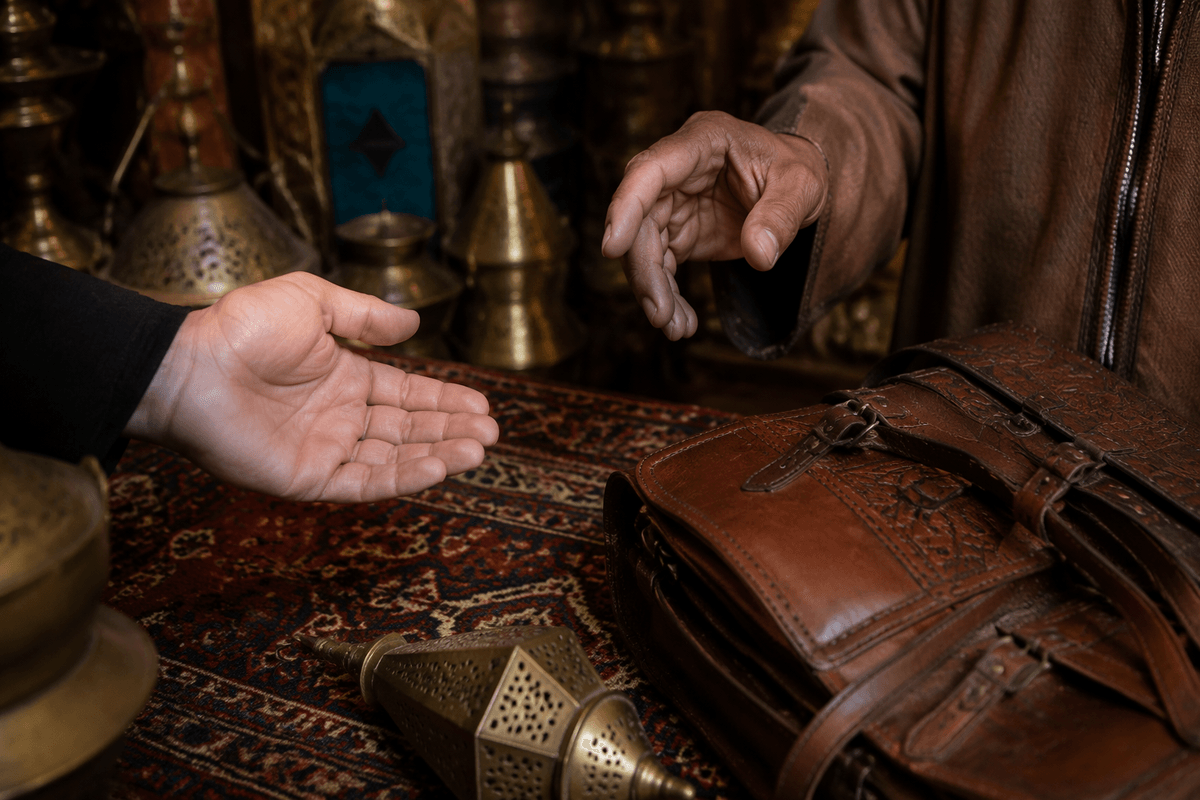
I tried to “read” the souk like a map—main alley must mean fixed prices, tiny side lane must mean bargains—until a guy selling babouches quoted me higher in a back corridor than the lantern shop two turns earlier. It was late afternoon, the call to prayer had just faded, and we were already juggling a tote bag and two mint teas. That’s when it clicked: “normal” here isn’t a single price, it’s a range that depends on location, finish, and how rushed you look.
In Marrakech souks, expect the first number to be a starting ritual, not a scam—especially for leather goods, lamps, rugs, and anything that takes effort to pack. For common items (scarves, small ceramics, spices), the swing is usually narrower; for big-ticket pieces (rugs, ornate lanterns), it can be dramatic. A workable rule when you don’t know the category: if the ask feels like “airport pricing,” start around one-third to one-half and see if they counter without theatrics. If they act offended but keep talking, you’re still in the game; if they go cold, you probably cut too deep for that shop.
To keep it polite and fast, anchor once, then do two small moves—no more. I’ll say, “I like it, but that doesn’t work for me,” offer my number, then let them counter; I come up a little, they come down a little, and we either shake hands or exit. This works best for couples who value momentum; if you want the absolute lowest price, you’ll need more laps, more comparisons, and more patience than a 3-day stopover usually allows.
Set your ceiling before you browse
I almost bought a brass lantern outside Rahba Kedima because the shopkeeper had already wrapped it in newspaper and my partner was giving me the “we should move” look. We were due at Le Jardin Secret in twenty minutes, and I could feel that tiny panic that makes any number seem acceptable. The mistake wasn’t the price; it was browsing without a limit when time was already the scarce thing.
Before you touch anything, set a ceiling per item and say it out loud to each other—quietly, like you’re choosing a restaurant budget. For a mid-budget couple on a three-day stopover, this is the clean trade-off: you might miss a “steal,” but you’ll avoid the slow bleed of small overpays and the big one you regret back at the riad. I like a two-number rule: a “happy price” you’d pay quickly, and a hard cap you won’t cross even if they throw in a smile, a story, and a free keychain.
Then browse like you’re timing a museum: five minutes of looking, then you either negotiate or you leave the lane. If you find something you like, ask the price once, counter once, and only climb toward your cap in small, boring steps. It works best when one of you plays the “clock” (keeps you moving) while the other plays the “face” (stays polite); if both of you start apologizing, the ceiling quietly disappears.
Negotiate like a local, stay polite
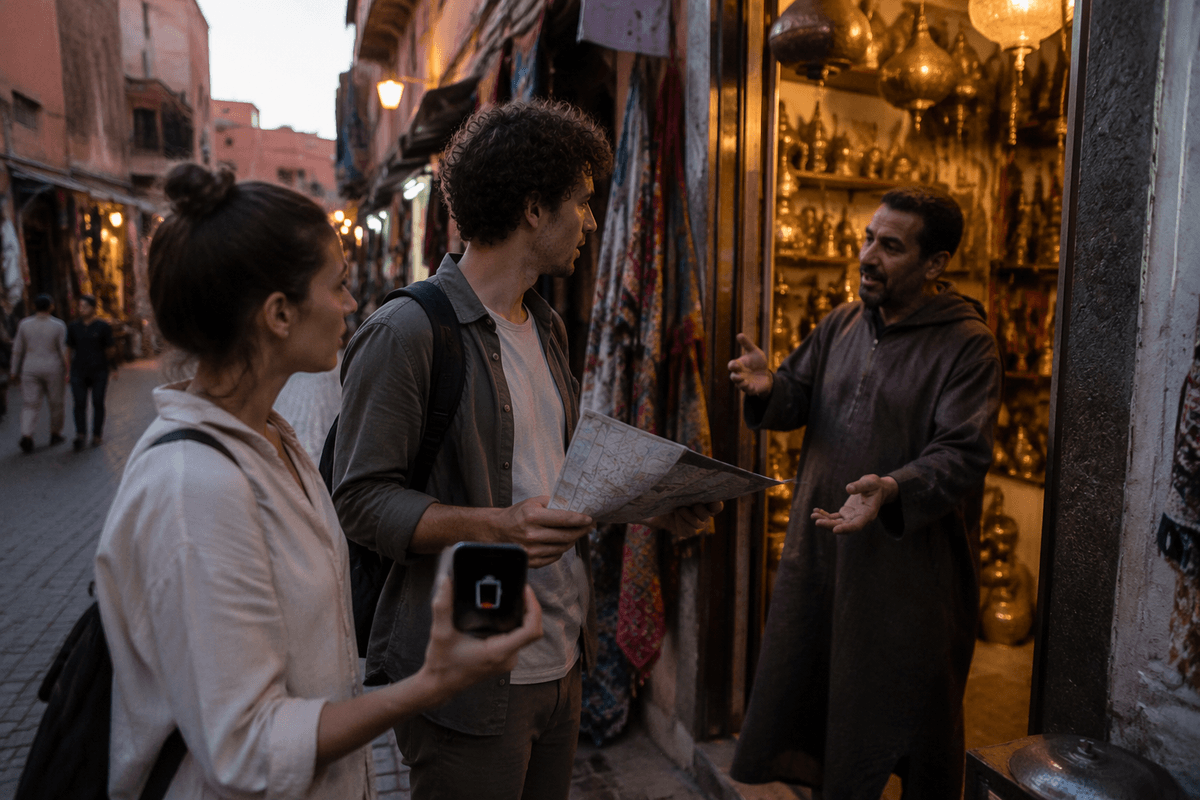
At 6:10 p.m., with our phone at 12% and the evening light flattening the souk’s colors, a man tried to steer us into his shop “just for two minutes.” My partner hesitated at the doorway while I held onto the map like it could negotiate for me. Saying yes would’ve cost time; saying no felt oddly personal.
The local-style move is to make it social before it gets numeric. Start with a greeting and one clear signal of intent—“Salam, I’m looking for a small lantern”—then ask the price once and let it land without reacting like it’s a joke. Your counter should be calm and clean (a single number, not a speech), and then you wait; silence works better than fast bargaining because it forces a real counter instead of performance. For a mid-budget couple on a tight schedule, two rounds is usually the sweet spot: enough to reach a fair range, not so much that you burn an hour to save the cost of a taxi ride.
Keep the politeness practical. If they keep pulling out “special prices” and calling you back by name, that’s often a sign you’re in the tourist lane—either bundle (“Two scarves for X?”) or move on. When you’re near your cap, stop negotiating and switch to closing: “If you can do X, I’ll pay now.” If they can’t, thank them, step out into the flow, and let your feet be the pressure instead of your tone.
My quick plan for first-timers
On our last morning, I checked the time—11:35—and realized we had exactly one loop through the souks before a 1:00 p.m. pickup back to the riad. A seller kept flipping a leather bag in my hands like it was already ours, and I could feel that familiar squeeze: pay and escape, or haggle and risk friction. The crowd in the lane made it worse; stopping meant becoming an obstacle.
Here’s the quick plan I’d actually use again if I only had three days. First, pick a “today price” for the item category before you touch anything (the number you’ll happily pay to keep the day moving), and a hard cap you won’t cross even if they throw in “gift.” When they quote, answer with one calm counter—usually about half to one-third of the ask if it’s clearly tourist-inflated—then let them work; silence beats speed here. Do two small moves max on your side, because the trade-off is saving money versus spending your afternoon proving a point.
If you’re close to your cap, switch to a clean close: “If you can do X, I’ll pay now.” If you’re not close, walk—politely and immediately—because the only leverage you really have is leaving. This approach works best for couples who want fair-enough pricing without draining the trip; if you want the absolute lowest, you’ll need more comparisons, more detours, and more patience than Marrakech heat usually invites.