The hard part isn’t travel—it’s making work fit
I stalled at the checkout screen with a €37 “non‑refundable” coworking pass in my cart and a three-week apartment hold expiring in 18 minutes. The flight was easy; the chain of commitments wasn’t. When you only have three months, every small booking becomes a bet on whether your workday will still function on the other side of it.
The hard part is designing your week so client calls, deep-focus blocks, and basic admin don’t collapse under novelty. Reliable Wi‑Fi is rarely the headline problem; it’s the trade-off between “cheap, central, fun” housing and “quiet, stable, router-in-the-room” housing, plus the limitation that you can’t troubleshoot connectivity during a design review. For US hours, a city that’s “perfect” on paper can be punishing in practice if you’re repeatedly ending meetings at 1:00 a.m.—great for nightlife, rough for consistency.
Legality and logistics add timing pressure. Tourist stays can be fine for a short test, but they don’t automatically make work activity clean, and hopping countries to reset days can create fatigue, higher transport spend, and a paper trail you may not want when taxes and residency questions show up later. If your priority is shipping good work with minimal stress, optimize for one base where you can lock internet, a backup workspace, and a safe, social neighborhood—then treat side trips as optional, not structural.
First month: test your setup safely
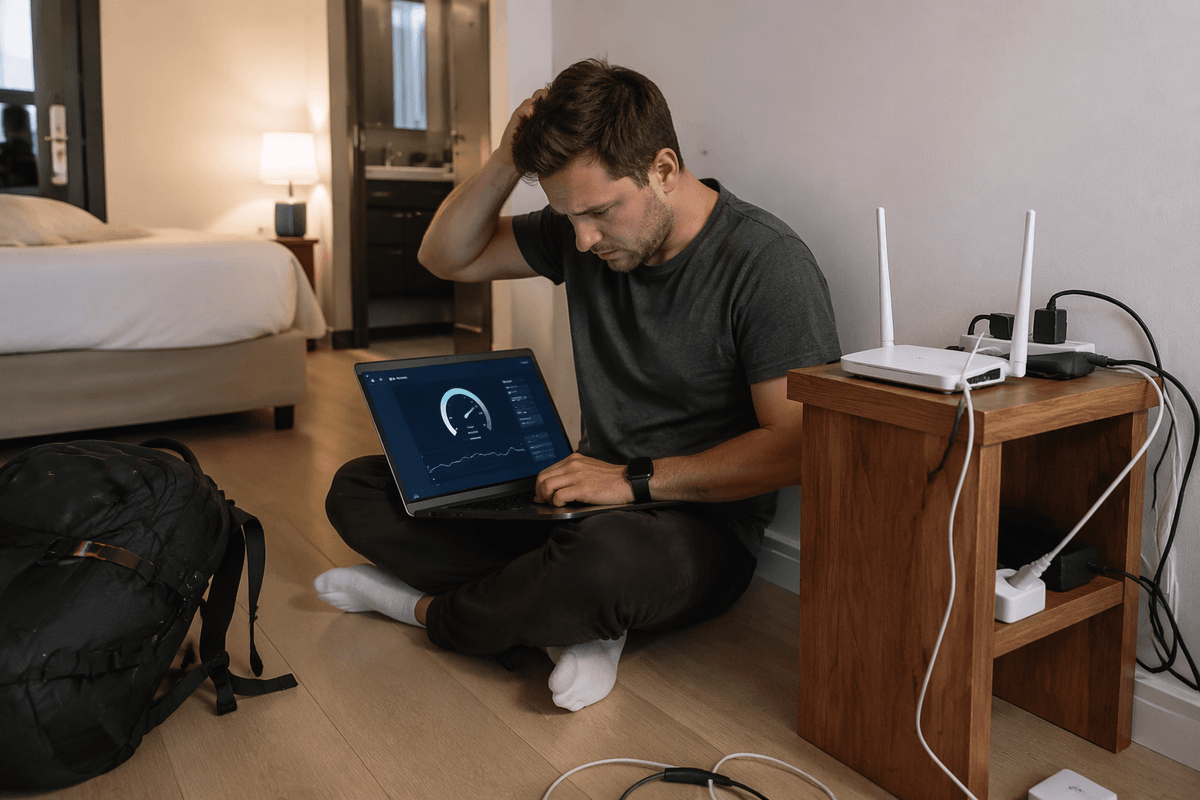
On day three, I was sitting on the floor beside the router, speed-test tab open, asking a host (politely, too politely) if the “fast Wi‑Fi” meant fiber or just optimism. My US-hours call block started in 40 minutes, and the backup plan was a café with playlist-level volume. That’s the first-month reality: you’re not proving you can travel—you’re proving your setup survives mild chaos.
Treat the first four weeks like a controlled experiment, not a victory lap. Choose one city where the time zone is merely inconvenient (late evenings) instead of punishing (regular 1:00 a.m. finishes), and cap commitments: a 2–4 week stay, a cancellable coworking day pass, and a second workspace you can reach in under 20 minutes. It costs a bit more than chasing the cheapest monthly deal, but it limits the downside if the neighborhood is louder than the listing or the desk situation is “kitchen chair forever.”
Run a setup checklist before you get ambitious: verify upload speed during your actual meeting hours, carry a hotspot or local SIM as a failover, and schedule one “admin morning” weekly for banking, receipts, and calendar drift. Legally, default conservative—tourist entry may be common for short tests, but it’s not a magic work permit, and you don’t want your three-month window eaten by a border surprise. If the first month feels boring, that’s a good sign; it means you’re buying consistency before you buy variety.
Country-hopping: visas, taxes, logistics

I had two tabs open at 11:43 p.m.—a $129 “change fee applies” flight and a visa PDF that kept using the word “remunerated.” My calendar said “design critique,” my passport said “tourist,” and the accommodation host wanted a deposit by midnight local time. It wasn’t fear exactly; it was the uneasy sense that a single checkbox could turn a fun hop into a compliance headache.
For a three-month trial, country-hopping works best when you treat visas like constraints, not vibes. A simple rule: pick places where you can enter cleanly, stay long enough to stabilize (think 3–5 weeks), and leave without “reset runs” that burn a whole workday. Tourist entry is common for short stays, but it’s not a universal work authorization; if your risk tolerance is low, prioritize destinations with clearer remote-work pathways or at least low-friction entry rules and consistent border practices.
Taxes and logistics are where constant movement quietly eats you. If you’re invoicing US clients, track days per country, keep clean receipts, and don’t let “I’m only here briefly” turn into zero documentation—especially if you bounce through multiple jurisdictions. Practical setup matters too: banking that won’t freeze you for foreign logins, travel insurance that actually covers outpatient care, and a time-zone plan that doesn’t stack late-night calls on top of transit days. If you find yourself booking flights to solve visa math, that’s usually the cue to slow down, not speed up.
Long-term base: housing, healthcare, community
I hesitated with my finger over “Pay deposit,” staring at a 30‑day apartment contract that wanted first month + a security deposit via bank transfer, not card. The listing promised “fiber,” but the router was in a locked cabinet in the hallway, shared with three other units. Compared with short stays, a base is cheaper per night, but the downside is you’re committing before you’ve lived the noise, the light, and the meeting-hours reality.
For housing, I look for boring signals: a desk you can sit at for six hours, a door that closes, and a host who can answer “upload speed at 9 p.m.” without guessing. A long-term place works for US-hours designers if you can sleep late and still have quiet evenings; it doesn’t work if your building treats midnight like a group project. The central and social usually means thinner walls, while a calmer neighborhood can add daily transit friction when you’re already stacking late calls.
Healthcare and community are the two things you don’t appreciate until you need them fast. Travel insurance can be fine for emergencies, but routine care, prescriptions, and a random clinic visit are where you find the limitations, so I keep policy docs saved offline and identify one reputable clinic within 20 minutes. Socially, coworking is less about vibes than repetition: two fixed days a week beats “maybe tonight,” especially when fatigue makes you default to staying in. If your base doesn’t make it easy to see the same people again, it’s not really a base—it’s just a longer stay.
My pick: start with one hub
I committed to one hub the moment the airline app offered a “free” change—then quietly added a $46 fare difference, a baggage reprice, and a new arrival time that landed 90 minutes before my Monday standup. I had been telling myself flexibility was the point, but my calendar didn’t care. With three months, the friction isn’t dramatic; it’s death-by-small-adjustment.
My pick is simple: choose one hub for 6–8 weeks, then take 7–10 day loops when you’ve earned them. Compared with rotating cities every week, one hub lets you lock a known-good desk, a known-good backup (coworking with phone booths), and a known-good sleep schedule for US hours—even if that means paying slightly more for “boring” neighborhoods and saying no to the cheapest, loudest deal. It works best if your client work is deadline-driven and you can’t risk a surprise router, a mystery construction project, or a two-hour hunt for quiet at 8 p.m.
Legally and financially, one hub reduces the number of times you’re improvising at borders, juggling SIM swaps, or scattering receipts across three currencies. You still track days and keep your documentation clean, but you’re doing it from a stable base rather than in transit. If you’re torn between a cheaper, constant-motion route and a steadier one, pick the hub, then let yourself roam only when your week is already working.